
Looking at the supercomputing center, or "walking" into the supercomputing center? -- 720 ° panoramic view of Hengtai Aipu supercomputing center "more, faster, better and less"
2019-07-18
In 1929, the term "supercomputing" (Supercomputing) first appeared in the New York World newspaper's story about "IBM building a large reporting machine for Columbia University;
In 1999, NVIDIA released the GeForce 256 circular processing chip, first proposed the concept of GPU;
In 2010, the supercomputing center (hereinafter referred to as "supercomputing center") independently designed and built by Hengtai Aipu has a floating-point operation speed of 2200 trillion times per second, and its operation speed and ability have reached the mainstream level in the industry.
Supercomputers are currently the most powerful computers on the planet, and their powerful computing power is amazing. As a comprehensive, collectivized and international comprehensive energy service provider, Hengtai Aipu Group, as a pioneer and leader in the field of energy exploration and development software, needs to process tens or even hundreds of terabytes of seismic data (Terabyte, commonly used TB means 1TB = 1024GB = 2 40 bytes), which puts forward quite high requirements on the hardware level of the supercomputing center and the software level of professional scientific calculation.
Scan and identify the two-dimensional code below or copy the link below. By arbitrarily adjusting the angle up, down, front, back, left and right or browsing and switching, you can understand Hengtai Aipu Supercomputing Center in 720 all directions and without dead angles. Real and realistic immersive experience, in-depth exchange of operational interaction, to give people the perception of the experience.
Supercomputing Center VR Panoramic Display QR Code:
Supercomputing Center VR Panoramic Display Link: https://720yun.com/t/rzx86ra2l7s9dzmlfw#

--- CPU/GPU Cooperative Computing Architecture
According to the U.S. Department of Energy in May this year, it announced plans to develop an E-class supercomputer code-named "Frontier" (Frontier) with a floating-point operation speed of 10 billion times per second. The "frontier" (Frontier) computing speed is 7 times faster than the "summit" (Summit), but the power is less than 3 times, saving nearly 50% of energy consumption, mainly due to the CPU-GPU heterogeneous parallel computing structure jointly designed by Cray and Chaowei. (Top 500, the world's supercomputing organization, launches the world's fastest 500 supercomputing rankings every six months. In the summer of 2018, "Summit" (Summit) ranked first in the Top 500, which is currently the world's fastest supercomputing).
In recent years, China's E-class supercomputing has also seen a trend of using a CPU architecture with multiple accelerators. Supercomputing does intensive scientific computing work, and its core component is not just the CPU, because the CPU is not the most efficient in performing tasks such as computing. The accelerator processor has a large number of computing units, in the correlation of data repetition processing, the accelerator has more advantages than the CPU, the acceleration ratio can be as high as hundreds of times, the more typical acceleration chip such as Nvidia's general-purpose GPU.
Hengtai Aipu Group, which has an international vision, foresight and advanced technology level, independently designed and built a supercomputing center with CPU/GPU collaborative computing architecture as early as 2010. It has a strong data processing capability and provides a strong computing support and guarantee for the exploration and development of oil and gas resources.
Hengtai Aipu Supercomputing Center has 17,000 CPU cores and 400,000 GPU cores, with a disk array storage capacity of 3138TB, a total hard disk size of more than 20000 TB, and a floating-point budget speed of 2200 trillion times per second.
In addition, Hengtai Aipu Supercomputing Center innovatively uses GPU mining cards for large-scale seismic data processing. Its computing power is equivalent to that of GPU professional cards or GPU general-purpose cards, but the price is lower, only 1/10 of the price of GPU professional cards. At present, the supercomputing center uses about 200 lump ore cards, which greatly reduces the construction cost of the supercomputing center without affecting the computing speed. At the same time, due to the smaller size of the mine card, four GPU mine cards can be inserted into one chassis slot, which not only greatly improves the computing power of the supercomputing center, but also improves the reliability and maintainability of the supercomputing center.
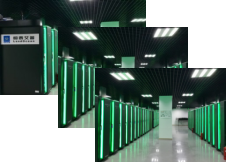

--- Floating-point operation speed is currently as high as 2200 trillion times per second.
If the speed of an ordinary computer is compared to the walking speed of an adult, the speed of a supercomputer can almost reach rocket speed.
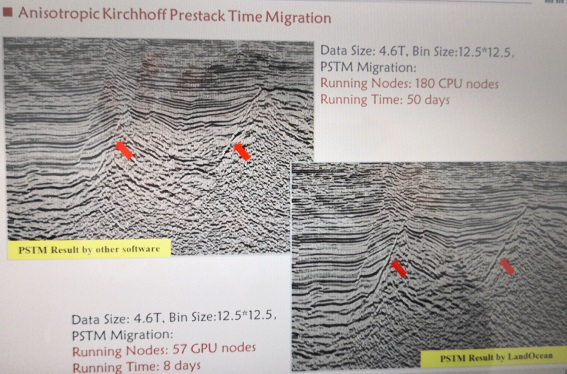
Comparison of processing time between Hengtai Aipu data center and other data processing systems
The above figure is a comparison chart of the time taken to process the same amount of data using Hengtai Aipu Supercomputing Center and other data processing systems. As can be seen from the figure, processing the same amount of data (4.6T) requires 50 days compared with 180 CPU nodes used by other systems. Hengtai Aipu Supercomputing Center only uses 57 GPU nodes, while the operation time is only 8 days.
The CPU/GPU collaborative computing architecture mode adopted by Hengtai Aipu Supercomputing Center greatly improves the processing speed of seismic data, reduces the processing time of data, and improves the ability of timely feedback of oil and gas exploration data.

--- Safety assurance, energy conservation and environmental protection have reached the first-class level at home and abroad
Hengtai Aipu Supercomputing Center not only has fast calculation speed and strong calculation power, but also has reached the first-class level at home and abroad in terms of construction cost, safety guarantee, energy conservation and environmental protection.
(1) won the national patent "room point refrigeration system":
The main task of the precision air conditioning system of the supercomputing center is to ensure the safe, stable, continuous and reliable operation of the cabinet and other equipment, to discharge the heat emitted by the equipment and other heat sources in the machine room in time, and to maintain the relatively constant temperature and humidity of the computer and its peripheral equipment. The "computer room point refrigeration system" of Hengtai Aipu Supercomputing Center adopts the innovative mode of air supply, power supply and signal line supply, and directly enters the interior of the cabinet for refrigeration. Compared with the old mode of overall space refrigeration of the traditional computer room, the "computer room point refrigeration system" has the advantages of precise refrigeration, low energy consumption, low noise and low refrigeration cost, and is more flexible in the later maintenance and transformation of computer room wiring or in the movement of equipment.
(2) Anti-static ground system
Ground engineering is also an important part of the supercomputing center. Traditional machine room ground laying generally use anti-static floor, this laying method of erection costs and maintenance costs are relatively high. Moreover, due to the overhead of pipelines, electrical facilities and air conditioning air outlet system under the floor, hidden space may have potential safety hazards of snakes, insects, rats and ants.
The ground system of Hengtai Aipu Supercomputing Center adopts dust-proof paint treatment process, which has the characteristics of low cost, low maintenance cost, high safety factor, less potential safety hazard, high utilization rate of computer room space and more convenient access to the computer room. And because there is no overhead floor, there is no hidden space underground, which also eliminates the risks caused by snakes, insects, rats and ants and the safety hazards of water leakage.
(3) Ceiling system:
Due to the 24-hour continuous operation of the supercomputing center, a certain amount of noise will be generated, so there are relatively high requirements for dust removal and noise reduction. Traditional computer rooms generally use perforated gypsum board or fiber as the ceiling of the computer room. This ceiling method has a slightly weaker noise reduction ability, and is prone to damp, dirt and dust falling off.
However, the ceiling system of Hengtai Aipu Supercomputing Center innovatively adopts the lattice structure aluminum foil composite material mode. Because the aluminum foil has a large reflection coefficient for sound, and the sound frequency and resonance frequency are closer to the sound absorption coefficient, it can form a stronger noise suppression ability, and the Senior high school low-frequency noise information can be hollowed out in the middle of the lattice structure, thus making the noise self-suppression and mutual elimination.

--- low construction cost, improve the economic efficiency of enterprises
Through innovative concepts and advanced design, Hengtai Aipu not only has reached the mainstream level of the industry in terms of computing speed and computing capability, but also has more economical construction and maintenance costs., Hengtai Aipu Supercomputing Center and its supporting facilities cover an area of nearly 1000 square meters, but the total construction cost and server equipment investment of the Supercomputing Center are only about 60 million yuan. Compared with the sky-high supercomputing center with similar computing power but construction cost may reach hundreds of millions or even billions of yuan, Hengtai Aipu Supercomputing Center greatly reduces the construction cost and improves the economic benefits of the enterprise.
Recommend News
NEW JCM pays tribute to China’s anniversary
2026-10-01
sz300157
Shanghai Stock Exchange (sh) Shenzhen Stock Exchange (sz) Venture (sz) New Third Board (sh) North Stock Exchange (bj) Hong Kong Stock Exchange (hk) US Stock (us)

DouYin
Youtube
Tiktok
NEW JCM GROUP CO.,LTD
Address: Building 4, Yard 3, Fengxiu Middle Road, Haidian District, Beijing
Telephone: 0086-10-56931000
E-mail: marketing@newjcmgroup.cn
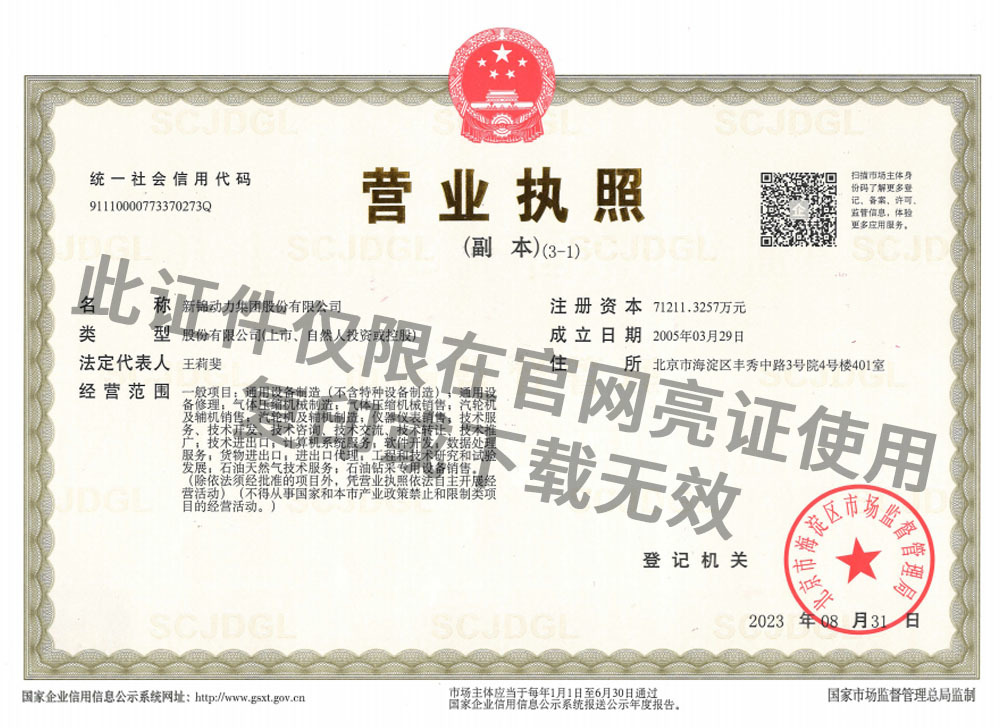
NEW JCM | SEO | Business License | Privacy Policy